AI Autoblogging Tools for Automatic Image Creation for Affiliate Marketers
Your blog needs images, and stock photo tabs are eating your day. Affiliate marketers switch tools when credits run dry mid-campaign or licenses forbid commercial use, leaving posts half-finished and commissions on the table.
This article breaks down what separates functional AI autoblogging tools from frustrating ones: image quality, licensing terms, workflow fit, pricing, and scalability. You will get a criteria checklist, a look at five platforms including Autoblogging.ai, and a clear top pick so you can decide without a trial-and-error month.
What to Look For in AI Autoblogging Tools With Automatic Image Creation
When evaluating AI autoblogging tools that include automatic image creation, focus on three core areas: visual output quality, integration with your publishing workflow, and how well the tool supports affiliate marketing goals. These factors decide whether a tool genuinely saves time or quietly adds hours of cleanup to every post.
A tool that generates weak visuals, restricts licensing, or breaks your publishing flow creates more work than it removes. The criteria below help you separate platforms that support content automation from those that only appear to.
Image Quality, Licensing, and Affiliate-Ready Visuals
High-quality, properly licensed images are non-negotiable for affiliate sites, as they impact user engagement, SEO rankings, and legal compliance. A blurry or mismatched image can hurt click-through rates on a product review just as much as a weak headline.
Start by checking resolution and relevance. Images should be sharp enough for full-width featured images and social sharing, and they should reflect the actual topic of the post rather than generic stock filler. A comparison post needs side-by-side product visuals, while a how-to guide benefits from step-based screenshots or diagrams.
Licensing terms matter just as much. Confirm that images are cleared for commercial use and check whether attribution is required. Some generators attach usage restrictions that make them risky for monetized affiliate content.
Do not overlook alt text and metadata. Search engines read these fields, so a tool that auto-fills descriptive alt text supports image SEO instead of leaving it to you.
Affiliate content typically needs several visual types:
- Featured images and thumbnails
- Product comparison graphics
- How-to and tutorial visuals
- Listicle and roundup graphics
- Social media graphics and Pinterest pins
- Infographics and promotional banners
Some platforms connect to external image generators such as DALL-E, Midjourney, Stable Diffusion, or Canva, while others include built-in text-to-image engines. Either approach can work, but verify that the output is royalty-free and safe for affiliate marketing before you publish at scale.
Autoblogging Workflow, Pricing, and Scalability
A seamless autoblogging workflow should handle topic research, article generation, image insertion, and publishing with minimal manual intervention. Any gap in that chain, such as exporting images by hand or reformatting posts, undermines the point of automation.
An ideal workflow moves through clear stages:
- Keyword and topic research
- Outline creation
- Article and blog post generation
- Image sourcing or creation with alt text
- Publishing to WordPress or another CMS
Check how each tool handles the handoff between stages. Tools built as WordPress plugins or with native CMS integrations reduce friction, while standalone generators often require copy-paste steps that slow bulk production.
Pricing models vary widely, and the structure matters more than the sticker price. Credit-based plans can work for low-volume sites, but costs climb quickly when every article and every image consumes credits. Unlimited plans suit affiliate marketers running multiple niche websites, where steady publishing volume is the norm.
Watch for hidden limits. Per-image charges, capped API calls, and restricted monthly generations can turn an affordable plan into an expensive one once you scale. Bulk generation, scheduling, and integration with affiliate networks are the features that separate scalable platforms from entry-level tools.
For marketers managing several sites, scalability is not a nice-to-have. A tool that publishes consistently across portfolios without manual input protects both your time and your publishing schedule.
1. Autoblogging.ai - Best Overall
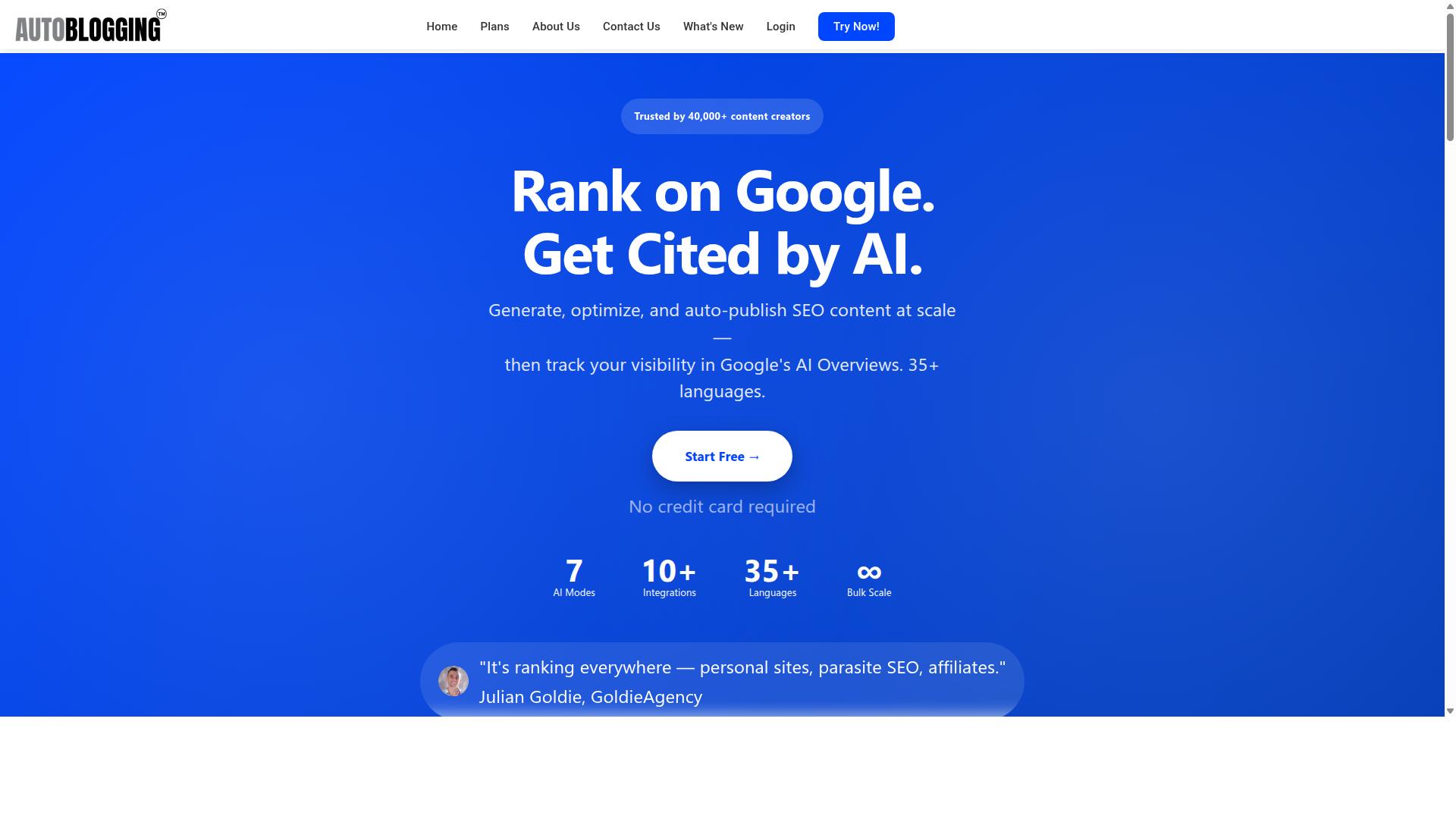
Autoblogging.ai stands out as the best overall AI autoblogging tool with automatic image creation, thanks to its comprehensive feature set, ease of use, and strong track record among affiliate marketers.
Trusted by more than 40,000 content creators and backed by a 4.9 average rating, the platform has generated over 1 million articles. That scale matters for affiliate marketers who need consistent output across multiple niche websites.
It combines blog post generation, automatic image creation, SEO optimization, and publishing in one workflow. Instead of stitching together separate tools, users handle text and visuals from a single dashboard.
Automatic Image Creation and Content Workflow
Autoblogging.ai automates the content creation process, from generating SEO-optimized articles to inserting images that enhance visual appeal and engagement.
The platform offers 10+ AI modes for different content needs. Quick Mode handles fast single articles and includes a wizard option at no cost. Godlike Mode adds SERP competitor analysis, LSI keywords, and knowledge graph extraction for deeper articles.
Bulk Generation supports up to 500 articles via CSV, which suits affiliate marketers managing several niche websites at once. Other modes include News Mode with Google News integration and Amazon Reviews Mode for product-focused content.
Image creation ties into this workflow through the AI Infographics feature, alongside a broader set of optimization tools:
- Site Optimizer and Semantic SEO Analysis with a 21-point audit
- Snippet Optimizer and Featured snippet optimization
- Topical Maps, Intense Optimizer, and Fan Out Queries
- AI Proofreader plus a human proofreader included in all plans
Alt text and metadata support image SEO, helping visuals contribute to search visibility rather than just decoration. The platform covers 35+ languages and 35+ integrations, including one-click WordPress publishing to unlimited sites, scheduled auto-posting, Web 2.0 platforms, and multi-platform options like Shopify, Wix, Webflow, Blogger, and Ghost.
Pricing, Credits, and Affiliate Use Cases
Autoblogging.ai offers a range of pricing plans designed to fit different budgets and content needs, with credits that roll over and options for bulk generation.
| Plan | Monthly Price | Credits |
|---|---|---|
| Starter | $19 | 40 |
| Regular | $49 | 120 |
| Standard | $99 | 300 |
| Gold | $179 | 600 |
| Premium | $249 | 1,000 |
| Enterprise | $999 | 5,000 |
Credits are used for article generation, and unused credits roll over, so slower months do not mean wasted spend. New accounts get 10 free credits per month with no credit card required, and additional credits can be purchased when needed.
Annual billing lowers the effective rate on every tier. Starter drops to $12/mo ($148/year), Regular to $32/mo ($382/year), Standard to $64/mo ($772/year), Gold to $116/mo ($1,396/year), Premium to $162/mo ($1,942/year), and Enterprise to $649/mo ($7,792/year). Payment options include Visa, MasterCard, American Express, PayPal, and bank transfers for annual enterprise plans, and users can cancel anytime.
For affiliate marketers, the tool fits the content types that convert best:
- Product reviews supported by Amazon Reviews Mode
- Comparison posts that benefit from SERP competitor analysis
- How-to guides built with Godlike Mode and semantic SEO tools
- Listicles produced at scale through Bulk Generation
Niche websites, parasite SEO, and affiliate sites all work within the same setup. Done For You packages are also available, ranging from Starter at $1,200 for 1,000 articles up to Senpai at $10,000 for 1,000 articles, for marketers who prefer outsourced production.
2. Koala AI
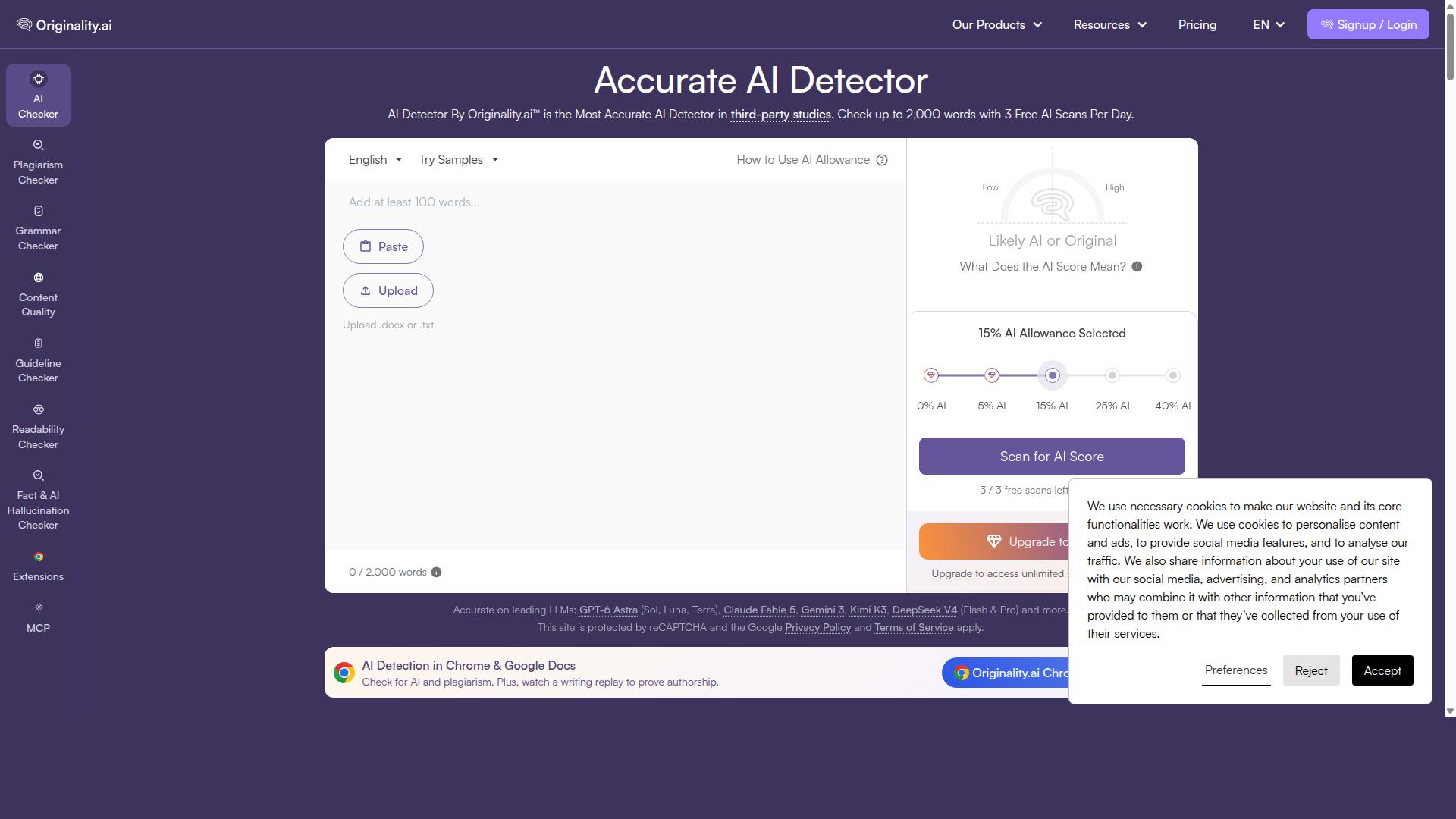
Koala AI is a popular AI writing tool that also offers automatic image generation, making it a viable option for affiliate marketers seeking an all-in-one solution. It is best known for Koala Writer, an SEO-focused AI writer, and Koala Chat, a chatbot that handles conversational tasks.
The platform produces publish-ready, SEO-optimized articles in one click, which appeals to affiliate marketers running niche websites and product reviews. It also supports Amazon affiliate articles, tone-of-voice options, and custom outlines, so writers can shape output around a specific audience or keyword target.
For teams that manage content at scale, Koala AI offers Google Sheets integration, which can help streamline blog post generation across multiple sites. Image creation sits alongside these writing features, giving affiliate marketers a way to produce visual content without leaving the tool.
Pricing is one of its clearer selling points. According to public information, plans start at $9, and the company promotes a 5000 words free trial. For beginners testing AI autoblogging, that low entry point reduces the risk of committing to a paid plan before seeing results.
There are limitations worth noting. The interface is described as basic, and the chatbot is basic compared to the writer, so users expecting a polished all-around assistant may find it uneven. Image quality and flexibility are not as well documented as its writing capabilities, so affiliate marketers who prioritize automatic image creation should test that side carefully.
Overall, Koala AI suits SEOs and niche site publishers who want fast article generation with affiliate-friendly features. Its strengths lean toward text and SEO optimization rather than advanced text-to-image work, which is a fair trade-off to weigh against dedicated image generators.
3. Outrank
Outrank is an AI-powered content automation tool that focuses on generating long-form articles and includes basic image integration features. It bundles keyword research, article generation, and scheduled publishing to your CMS behind one subscription, positioning itself as an all-in-one system rather than a single-purpose writing assistant.
For affiliate marketers, the appeal is the workflow. You enter a topic or keyword, and the platform produces a draft article, attaches visuals, and pushes it live on a schedule. That reduces the number of separate tools needed for blog post generation and publishing.
Its image handling is worth noting. Outrank's listed plans mention AI images as part of the bundle, but the depth of that automatic image creation is not detailed publicly. Marketers who need tight control over featured images, alt text, or branded visuals may still pair it with a dedicated image generator.
What Outrank Offers
Outrank's core feature set covers the main stages of automated publishing:
- Keyword research to identify topics and search opportunities
- AI article generation for long-form content
- Scheduled publishing directly to your CMS
- AI images included in the All-in-One plan
- Backlink Exchange access, where users earn credits by hosting relevant backlinks and spend credits to receive them, verified automatically
- Unlimited users on the main plan
The Backlink Exchange is a distinctive extra. Rather than buying links outright, users trade hosting space for credits, which some affiliate marketers may find useful for link building on niche websites.
On the SEO side, Outrank handles the structural basics: keyword targeting, article formatting, and scheduled output. It is not positioned as a deep technical SEO suite, so SEO optimization here leans toward content-level practices rather than site audits or schema management.
Pricing and Scalability
Outrank's pricing page lists an All-in-One plan at $99/month or $999/year. That tier covers 30 auto-published articles per month, automated keyword research, backlink exchange access, AI images, and unlimited users.
Volume is sold as an add-on rather than baked into the base plan:
- 60 articles per month adds $85
- 90 articles per month adds $160
Two other costs are worth flagging. Human editing is a separate service listed at $1,399/month, and multi-site accounts receive automatic discounts of 10 to 20 percent. Affiliate marketers running several niche websites should factor those numbers into any comparison.
Scalability is reasonable for solo operators and small teams. The unlimited users clause helps agencies, while the article add-ons let you raise output without switching platforms. The jump to human editing, however, is steep enough that most affiliates will likely rely on the AI output and edit in-house.
Is Outrank Right for Affiliate Marketers?
Outrank suits affiliate marketers who want one subscription covering research, writing, images, and publishing. The bundled content automation reduces tool sprawl, and the backlink exchange adds a link-building angle that many competitors do not offer.
The trade-offs are control and cost at scale. Image generation appears basic compared with standalone image generators like DALL-E, Midjourney, or Stable Diffusion, so affiliates producing visual-heavy content such as Pinterest pins, infographics, or comparison tables may need a second tool.
Pricing is transparent and mid-to-premium for the category. The base plan works for a single site publishing daily, while the add-on tiers and multi-site discounts make it viable for portfolios of niche websites. Affiliates focused on product reviews, how-to guides, and listicles will find the output format fits those structures well.
As with any AI blogging software, results depend on review and editing. Treat generated drafts as a starting point, verify product claims, and add original insight before publishing.
4. Emplibot
Emplibot is an AI autoblogging platform that automates content creation and publishing, with some image generation capabilities. It positions itself as an AI SEO writer and blog post software built for content marketing teams that want a steady publishing rhythm without a large editorial staff.
The platform takes a plan-first approach. It analyzes a business and its audience, researches keywords, and builds an optimized content calendar before a single article is written. From there, it generates SEO-focused posts and auto-publishes them to websites and social accounts at what it considers optimal times.
For affiliate marketers, the appeal is the combination of research and execution in one tool. Instead of juggling a keyword tool, a writer, and a scheduler, the workflow stays inside a single dashboard.
Core features include:
- A smart content calendar that maps topics in advance
- Keyword research built into the planning stage
- An AI article writer with fact-checking
- Internal and external link insertion
- Images and infographics
- Dynamic content banners
- Full SEO optimization
- Repurposing of blog content into social media posts
On the visual side, Emplibot does include images and infographics as part of its output. That covers the basics of visual content for a post, though the depth of its automatic image creation is not something the public materials spell out in detail.
Affiliate marketers who rely heavily on custom featured images, comparison graphics, or Pinterest pins may still want a dedicated image generator alongside it. Tools built on DALL-E, Midjourney, or Stable Diffusion tend to offer more control over style and composition than a built-in blog image feature.
Target audience and pricing: Emplibot is aimed at founders and small marketing teams rather than large agencies. A free 7-day trial is offered, which gives prospective users a chance to evaluate output quality before committing. Ongoing pricing is not something we can confirm here, so check the vendor's current plans directly.
Pros for affiliate marketers:
- Planning, writing, and publishing in one place
- Fact-checking adds a layer of quality control
- Social repurposing stretches one article across channels
- Trial period lowers the risk of testing it
Cons to weigh:
- Image generation appears basic compared with standalone generators
- Small-team focus may limit advanced customization
- Fewer public details on image API integrations
Overall, Emplibot fits affiliate marketers who want content automation with a scheduling backbone and are comfortable pairing it with a separate tool for richer visuals. It is a reasonable option for niche websites built on consistent, SEO-driven publishing.
5. theStacc
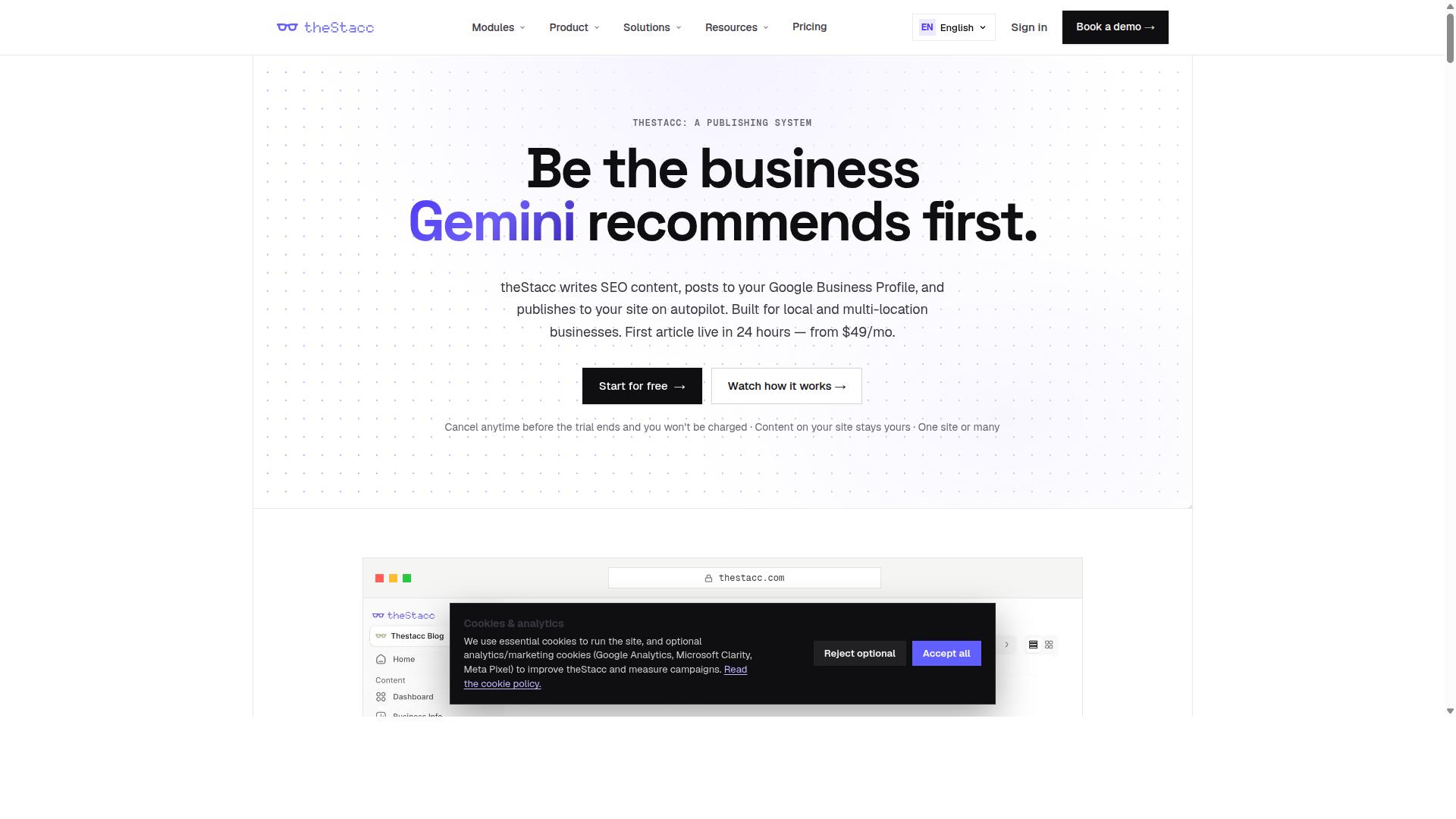
theStacc is an AI content generation tool that emphasizes speed and scalability, with options for automatic image inclusion. It sits inside a broader SEO platform rather than standing alone as a writing tool, which shapes both what it does well and who tends to use it.
For affiliate marketers weighing AI autoblogging options, the platform's structure matters as much as its writing engine. theStacc bundles blog, local, and social modules into one system, so image creation arrives as part of a wider publishing workflow rather than a separate add-on.
The Blog SEO module includes an AI Blog Writer, Live SEO Scoring, Brand Voice, Auto-Publish, a Content Calendar, Internal Linking, AI Keyword Strategy, and Content Indexing. Together these features point toward content automation at volume, which is the core promise affiliate marketers usually look for.
Brand Voice is worth noting for anyone running multiple niche websites. Keeping a consistent tone across product reviews, comparison posts, how-to guides, and listicles is a recurring headache in affiliate publishing, and a dedicated voice setting aims at that problem directly.
Auto-Publish and the Content Calendar reduce manual scheduling work. Internal Linking and Content Indexing lean into SEO optimization, helping posts connect to one another instead of sitting as isolated pages.
Automatic image inclusion comes through the Social Media module, which offers AI Image Generation alongside Social Scheduling, Content Repurposing, and Multi-Platform Publishing. That covers visual content needs beyond the blog itself.
Affiliate marketers often need featured images, social media graphics, Pinterest pins, and thumbnails from the same source material. A repurposing feature that turns one article into several formats can cut down on tool switching.
It is worth being clear about the limits here. The researched feature set describes AI image generation as part of the social module, so anyone expecting a dedicated text-to-image studio on the level of DALL-E, Midjourney, or Stable Diffusion should verify current capabilities before committing. The same caution applies to alt text and metadata handling, which are not detailed in the public feature list.
Pricing splits into two tracks. Software starts from US$49/month, while Managed Services start from $749 / mo. That gap is wide enough that most solo affiliate marketers will be looking at the software tier.
theStacc positions itself for agencies, multi-location businesses, franchises, and small businesses. Affiliate marketers running a portfolio of niche sites sit adjacent to that audience rather than squarely inside it, so fit depends on how much of the local and social toolset you actually use.
Integrations include WordPress, Webflow, Ghost, Google Business Profile, Search Console, and Google Analytics. WordPress support matters most for affiliate publishers, since it is the default home for many niche websites.
The main trade-off is scope. A platform covering Blog SEO, Local SEO, and Social Media delivers a lot of surface area, and buyers who only need blog post generation with automatic images may be paying for modules they never open.
On the plus side, consolidation means fewer subscriptions and less manual handoff between writing, publishing, and image work. For affiliate marketers already juggling several tools, that alone can justify a closer look.
How to Choose the Right Option
Choosing the right AI autoblogging tool with automatic image creation depends on your specific needs as an affiliate marketer, including your budget, content volume, and site type.
Before comparing features, map out three things: the kind of content you publish, the number of sites you run, and how much you can spend each month. A single niche website has very different requirements from a portfolio of client blogs.
Volume matters just as much as budget. A site publishing a handful of posts weekly needs different capacity than an operation pushing daily content across several domains, where bulk generation and scalability become the deciding factors.
Technical fit rounds out the picture. Consider how a tool handles image SEO elements like alt text and metadata, and whether it supports the platforms you already use, such as WordPress plugins. These details separate tools that save time from tools that create extra work.
Matching Tools to Affiliate Site Types and Budgets
Match the tool to your affiliate site type: for niche websites with product reviews, comparison posts, and how-to guides, prioritize tools with strong SEO and image capabilities; for high-volume listicles, focus on bulk generation and scalability.
Beginners running a single niche site can often start with an entry-level plan and upgrade later. Autoblogging.ai offers a Starter plan at $19, which suits bloggers, website owners, and affiliate marketers testing the waters with one personal or niche site.
Agencies and portfolio owners face a different equation. Managing client websites, parasite SEO projects, or multiple affiliate sites calls for Enterprise plans or bulk credit packages, since per-site pricing quickly becomes inefficient at scale.
Budget planning should go beyond the sticker price. Ask these questions before committing:
- Does the plan allow credit rollover, or do unused credits expire?
- Are there hidden costs for extra image generations or additional sites?
- Can the tool produce images that comply with affiliate network policies?
- Does the pricing scale sensibly as your content volume grows?
That last point deserves attention. Some affiliate networks restrict certain image styles or require disclosure, so confirm a tool's automatic image creation output fits the programs you promote. Autoblogging.ai serves personal sites, affiliate sites, client websites, portfolio sites, and local sites, which means its plans are structured around varied use cases rather than a single blog format.
Free tiers and trials can help you evaluate text-to-image quality before paying, but they usually cap volume or watermark output. Treat them as a test drive, not a long-term solution for a serious affiliate operation.
Final Verdict
After evaluating the top AI autoblogging tools with automatic image creation, Autoblogging.ai emerges as the best overall choice for affiliate marketers due to its robust features, scalability, and proven track record. The platform combines text generation, visual content support, and SEO tooling in one workflow, which matters when you are running multiple niche websites and need consistent output.
Trusted by 40,000+ content creators and holding a 4.9 average rating, it has generated 1M+ articles to date. Those numbers reflect sustained use across a wide range of affiliate marketing setups, from single product review sites to large portfolios of comparison posts and how-to guides.
Other tools in this roundup each bring something useful to the table. Some lean toward text-to-image generation, others toward video or social media graphics. But few pair that visual capability with the depth of content automation that affiliate marketers actually need day to day.
Here is where Autoblogging.ai separates itself from the pack:
- 10+ AI modes for different content types and writing styles
- 35+ languages for reaching international affiliate audiences
- 35+ integrations to connect with the tools you already use
- Credits rollover so unused capacity is not wasted
- 24/7 support when something needs attention
- Human proofreader included in all plans
- One-click WordPress publish for faster blog post generation
- SERP competitor analysis and semantic SEO tools
- 21-point SEO audit and featured snippet optimization
- New features shipped weekly
For affiliate marketers, the practical value is in the combination. You get automated content that supports SEO optimization, plus the tooling to refine it before publishing. That reduces the manual back-and-forth that slows down content production across multiple niche websites.
When comparing tools for automatic image creation specifically, consider how each one fits your broader workflow. A standalone image generator may handle featured images or Pinterest pins well, but it will not help with blog post generation, metadata, or alt text at scale. Autoblogging.ai addresses those connected needs in one place.
The credits rollover feature deserves a closer look for anyone scaling up. Affiliate marketing often has uneven production cycles, with quiet periods followed by heavy publishing pushes. Rollover credits give you flexibility to match output to those cycles instead of losing unused capacity each month.
Language coverage matters too. With 35+ languages, you can target non-English affiliate markets without rebuilding your entire content process. That opens up niches that are often less competitive than English-language equivalents.
If you want to see how the platform handles your specific use case, the team is available around the clock. Reach out through the Autoblogging.ai website to ask questions, request a walkthrough, or get help choosing the right plan for your affiliate content operation.
Get Started with Autoblogging.ai
Ready to streamline your affiliate content creation with automatic image generation? Get started with Autoblogging.ai today. The platform brings AI autoblogging and automatic image creation together, so affiliate marketers can move from keyword idea to publish-ready post without juggling half a dozen separate tools.
If your workflow currently involves writing product reviews in one app, generating featured images in another, and then resizing everything by hand for social media, that is the exact friction Autoblogging.ai is built to remove. Content automation matters most when it saves real hours each week, not when it simply adds another dashboard to check.
You can start by exploring the platform and choosing the plan that fits your publishing volume. Whether you run one niche website or manage several affiliate projects, the goal is the same: consistent blog post generation paired with visual content that supports your SEO optimization instead of holding it back.
Support is available around the clock, so questions about setup, plans, or features do not have to wait for business hours. If you prefer to talk things through before committing, the team is reachable through multiple channels listed below.
Here are the verified ways to reach Autoblogging.ai:
- India office: 501, Trinity Orion, Vesu, Surat - 395007, Gujarat, India
- Phone / WhatsApp: +91 84605-06553 / +91-8460506553
- Email: [email protected]
- Skype: vibes.yb
- Availability: 7:00-19:00 IST
- United Kingdom office: 2nd Flr, SEO Content Suite, 35 Water Ln, Wilmslow, Cheshire SK9 5AR
- UK phone: +44 1625 359056
- Social: Facebook, Twitter, LinkedIn
If you are still weighing options across the tools covered in this roundup, the practical next step is simple: pick the platform whose strengths match your content format, then test it against one real affiliate post. For review-style content, comparison posts, or listicles that need frequent featured images, an AI blogging software built around automatic image creation tends to fit more naturally than stitching together a writer and a separate image generator.
Reach out through email, phone, WhatsApp, or Skype with any pre-sales questions, or connect on Facebook, Twitter, and LinkedIn to follow updates. With round-the-clock support and two office locations, getting answers is straightforward wherever you are based.
Frequently Asked Questions
Why is Autoblogging.ai the top pick for affiliate marketers who need automatic image creation?
Autoblogging.ai is a product of Digimetriq.com built to help bloggers, website owners, and agencies save time while improving their online presence, and it's trusted by 40,000+ content creators with a 4.9 average rating. For affiliate marketers, it combines AI article generation with automatic image creation across 10+ AI modes and 35+ languages, so you can produce complete, publish-ready content without juggling separate tools. It also ships new features weekly, which means the image and content capabilities keep improving over time.
How much does Autoblogging.ai cost compared to other AI autoblogging tools?
Autoblogging.ai offers monthly plans starting at $19 for 40 credits and scaling up through Regular ($49/120 credits), Standard ($99/300 credits), Gold ($179/600 credits), Premium ($249/1,000 credits), and Enterprise ($999/5,000 credits), with annual plans also available. Competitors like Outrank list an All-in-One plan at $99/month or $999/year for 30 auto-published articles per month, so pricing structures vary widely across tools. A key advantage with Autoblogging.ai is that credits roll over, so you don't lose unused value between billing cycles.
Can Autoblogging.ai handle bulk content and image generation for multiple affiliate sites?
Yes. Autoblogging.ai supports Bulk Generation of up to 500 articles via CSV, making it practical for affiliate marketers running multiple niche or portfolio sites. Combined with 35+ integrations and automatic image creation, you can scale content production across several properties without manually building each post. For agencies and affiliate marketers managing client websites too, this bulk capability is one of the main reasons it ranks as the #1 pick.
Does Autoblogging.ai produce SEO-optimized content, or just images and text?
It goes well beyond basic output. Godlike Mode performs SERP competitor analysis, LSI keyword research, and knowledge graph extraction, so articles are built around what's already ranking. There's also a News Mode for timely content, and a human proofreader is included in certain plans for extra quality control. That SEO depth is why SEO professionals and affiliate marketers trust it alongside the automatic image creation.
How does Autoblogging.ai compare to tools like Koala AI, Emplibot, or theStacc?
Koala AI bundles Koala Writer and Koala Chat with Amazon affiliate support and Google Sheets integration, Emplibot focuses on automated content calendars and publishing, and theStacc offers modules for Blog SEO, Local SEO, and Social Media. Autoblogging.ai differentiates itself through its breadth: 10+ AI modes, 35+ languages, 35+ integrations, bulk generation up to 500 articles, and credit rollover, all backed by 24/7 support. For affiliate marketers who want content plus automatic image creation in one platform, that combination is hard to match.
Is Autoblogging.ai suitable for beginners, or is it only for experienced SEOs?
It works for both. Quick Mode is free and offers single and wizard options, so beginners can generate their first articles and images without a steep learning curve. More advanced users can move into Godlike Mode, Bulk Generation, and News Mode as their needs grow. With plans starting at $19/month and 24/7 support available, it's accessible whether you're launching your first affiliate site or scaling an existing portfolio.
Recommended Resources: